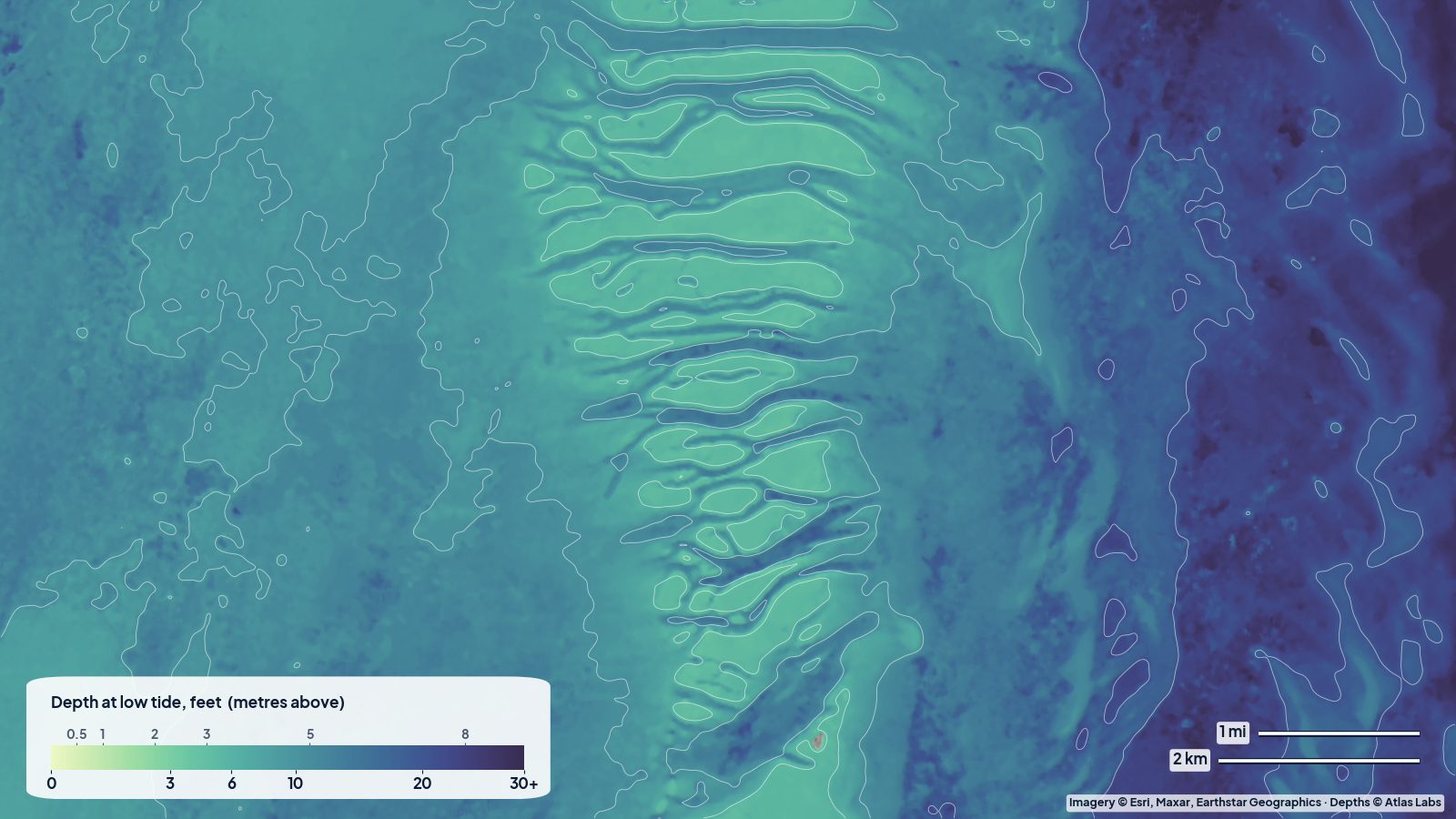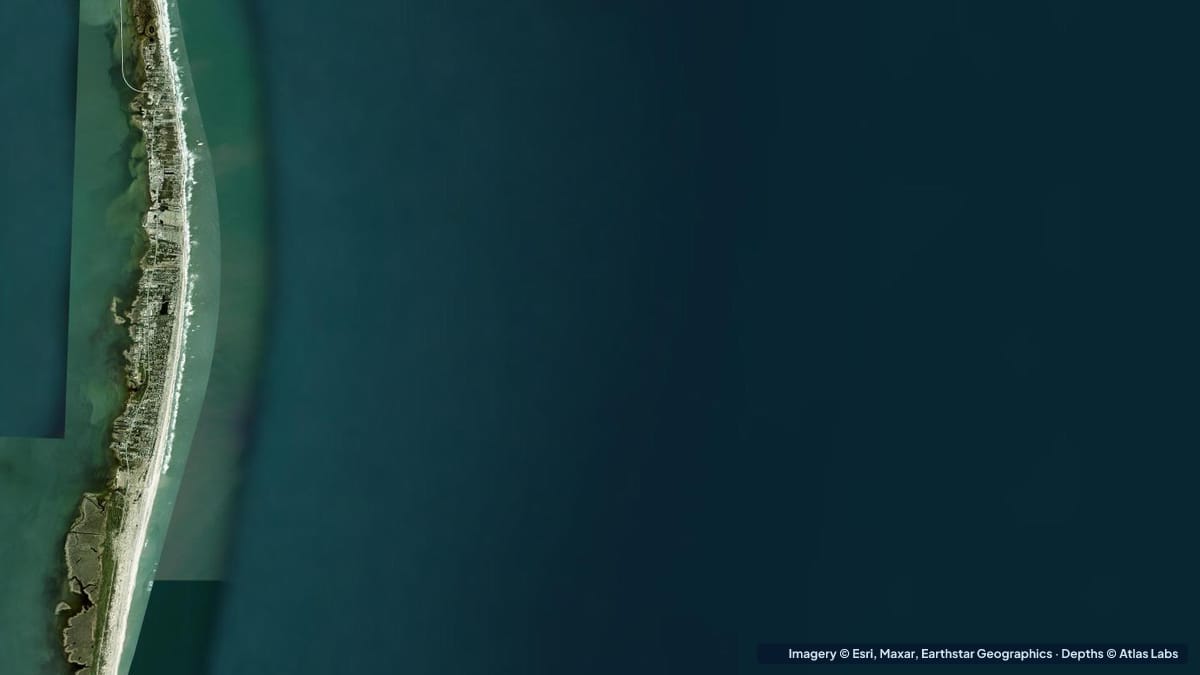
Everyone comes to the Outer Banks for the ocean, but the sound side is where paddlers, windsurfers, kiteboarders and wade anglers spend their days. Pamlico Sound, behind Hatteras and Ocracoke islands, is the largest lagoon on the US east coast and one of the shallowest for its size: most sources put the average depth at about 5 to 7 ft (1.5 to 2.1 m), with a maximum around 26 ft (8 m). Along the island shore it is shallower still, with waist-deep flats stretching a mile or more offshore. This guide covers the sound side of Hatteras Island with notes on Ocracoke: typical depths by zone, launches, wind and tide, hazards and draft. The satellite depth map for this cell is updated regularly.
What the bottom looks like
- Island-shore flats: firm sand with patches of eelgrass and shoalgrass, shelving very gently away from the beach. The famous Canadian Hole and Haulover area between Avon and Buxton is a shallow sand flat that stays knee to waist deep for a long way out.
- Grass beds: extensive seagrass meadows along the sound side of Hatteras and Ocracoke, important for fish, crabs and clear water.
- Sloughs and channels: a few natural channels and dredged ferry and harbour channels cut across the flats, including the ones into Hatteras Harbor, Rodanthe and Silver Lake at Ocracoke.
- Open sound: a broad, shallow basin of mud and sand that gets choppy fast in wind.
- Inlets (Oregon, Hatteras, Ocracoke): deep, fast and constantly shifting, with breaking shoals on the ocean side.
Approximate depth by zone
Typical ranges only. Pamlico Sound has almost no lunar tide; wind sets the water level. Check the live map and the wind forecast.
- Flats within a few hundred yards of the island shore: roughly 1 to 3 ft (0.3 to 0.9 m), with knee-deep water a long way out at Canadian Hole, Salvo and Frisco.
- Flats out to about a mile offshore: roughly 2 to 5 ft (0.6 to 1.5 m).
- Open sound: roughly 5 to 7 ft (1.5 to 2.1 m) on average, deeper in the middle.
- Dredged harbour and ferry channels: roughly 8 to 12 ft (2.4 to 3.7 m).
- Inlets: roughly 10 to 30 ft (3 to 9 m) in the channel, with shoals rising to the surface nearby.
- Ocracoke sound side and Silver Lake approach: flats of roughly 1 to 4 ft (0.3 to 1.2 m) with a marked channel.
Launch points and boat ramps
- Canadian Hole / Haulover Day Use Area (between Avon and Buxton, Cape Hatteras National Seashore): parking, a sound-side beach and the most famous windsurf, kite and paddleboard launch on the East Coast.
- Salvo Day Use Area and Rodanthe sound-side accesses: sandy launches onto shallow flats, good for beginners.
- Frisco and Hatteras village sound-side accesses: more carry-in spots; Hatteras Harbor has ramps for small boats.
- Avon and Buxton public ramps: trailer ramps for skiffs working the sound.
- Ocracoke (Silver Lake and NPS ramp): ramps and kayak launches in the village, with rentals.
- Nags Head and Kitty Hawk sound-side accesses (Roanoke Sound): family-friendly launches further north.
Best tide, wind and season
- Tide: Effectively none across most of the sound; the wind is the tide. A strong south-west wind pushes water onto the Hatteras shore and raises the flats; a north-east wind drains them.
- Wind: The Outer Banks are windy, which is why the sailors come. Paddlers should go early, stay close to the island shore, and plan to return with the wind behind them. Afternoon south-westerlies of 15 to 25 knots are normal in summer.
- Season: May to September for warm water and crowds; September and October for the best wind, clearer water and excellent fishing; winter is empty and cold. Hurricane season (August to October) can rearrange the inlets and flood the sound side.
Hazards
- Wind: The main hazard. A paddler blown offshore across Pamlico Sound faces miles of open water. Stay near shore in anything above 15 knots.
- Sound-side flooding and surge: North-east winds and tropical systems push water over the island from the sound side.
- Inlets: Oregon and Hatteras inlets are dangerous for small craft; shoals shift and breaking seas form on the ebb.
- Boat and ferry traffic: The ferry channels to Ocracoke and the fishing-fleet channels are busy.
- Stingrays, jellyfish and oyster shell: Shuffle your feet on the flats and wear shoes.
- Lightning: Summer storms cross the sound quickly.
Kayak and skiff draft guidance
Kayaks and paddleboards (4 to 6 in, 10 to 15 cm of draft) can go anywhere on the sound-side flats; after a north-east wind you may have to walk a long way to find paddling water.
Skiffs and bay boats drawing 6 to 18 in (15 to 45 cm) can run the open sound and the channels, and should slow down well short of the flats. Sailboats drawing 4 ft (1.2 m) or more should stay in the marked channels; the sound’s flats catch cruisers every season. Allow at least 1 ft (0.3 m) of margin above your draft, and more when the wind is north-east.
Frequently asked questions
How deep is Pamlico Sound?
On average about 5 to 7 ft (1.5 to 2.1 m), with a maximum near 26 ft (8 m). Along the Outer Banks shore the flats are often only 1 to 3 ft (0.3 to 0.9 m) for a long way out.
How deep is the water at Canadian Hole?
Shallow and flat: typically knee to waist deep, roughly 1 to 3 ft (0.3 to 0.9 m), for several hundred yards offshore, which is why it is so popular for learning to windsurf and kite.
Does Pamlico Sound have tides?
Barely. Wind direction and strength set the water level across most of the sound.
Is the sound side of the Outer Banks good for kayaking?
Excellent, especially for beginners and families, as long as you launch early, stay near shore and respect the wind.
Can I fish the Outer Banks sound side from a kayak?
Yes. Speckled trout, redfish and flounder feed on the grass flats and sloughs, and the shallow water suits kayaks and wading perfectly.
Related reading
- Chesapeake Bay eelgrass flats depth map
- Chatham and Cape Cod flats depth map
- Sebastian Inlet depth map
Safety note: ShoalScope depth maps are satellite estimates for planning only and are not for navigation. Wind changes Pamlico Sound water levels by a foot or more. Use official charts, check the forecast, and wear a life jacket.